Sunday, 30 August 2015

Craftsy Workshop: a Skype Rehearsal


I have just a few days to prepare for my trip to Denver. It's a wee bit scary and I'm feeling a bit frazzled, as there's still a fair bit of prep to do before I am ready to be filmed.


I'm so pleased that I front-loaded the most time-consuming element and got the main content for the seven lessons planned out months ago, when I was first commissioned. Now I have to go through it all again though, fleshing out the detail and scripting certain sections of it. There will be an auto-cue apparently: though I don't want to be 'reading' what I am saying, the prompts need to be fairly detailed, as there is so much information to get across. 


I'm finding some bits and pieces which need to be changed too - as I rehearse the lessons aloud, I keep tripping on elements which don't quite work properly, or are too complicated. 

Before my holiday, I had to do a run-through of one lesson for my producer in Denver, using Skype, so he could see how it was coming, check my timings, and get a feel for how the class would work generally. Unfortunately, at that point I was still knee-deep in the final editing of my sketching book, so I had no time to rehearse properly. It was a bit ragged, to say the least. I did lots of rambling on too, so took way more time than I needed!


It'll feel better though in a day or two, once I've had the chance to immerse myself in the material and get my head back around what I was doing when I was last working on it. I feel like I've been juggling too many balls of late.


When I get to Denver, we have a whole day set aside for rehearsals, so it feels like I will have plenty of opportunity for fine-tuning. Thank goodness. That feels reassuring, as my sketching book has taken up so much of my head-space recently, I have barely had time to think about Denver until now. Right, back to it...

Friday, 28 August 2015

Nice Article about My Book Illustrations


Back in February this year, I travelled to Lincoln to do a couple of days of lectures and workshops for Bishops Grosseteste University. I was a little nervous, as it was a bit different to what I normally do, since I was working with trainee teachers. I have worked with teachers and librarians before, but not for a while. It turned out to be a smashing job though, as everyone was so lovely and everything went down well. 

As an little added extra, I did an interview with a couple of 2nd year students for the university's magazine Hullabaloo! I then forgot all about it until a copy arrived through my postbox. It is a really nice article, in a special English Literature edition. 


I am hopefully enjoying my well-earned week off at the moment, having a relaxing time, drawing and painting in the wonderful Lake District landscape. I do hope it's not been raining too much! 

Anyway, I thought that I would post the Hullabaloo article to give you something to look at while I am away (hope it's clear enough to read when enlarged).

Wednesday, 26 August 2015

Planning Meeting: Chapter Headers


While I was in London with the publisher of my Sketching People book, we sorted out various other jobs, as well as photographing all the demos I showed you last time. 


One task I had deliberately left until the end was selecting images to use for the chapter headers. Most of the pages in the book have 6 - 8 sketches per spread, but at the start of each chapter, I can have one sketch taking up a whole spread. 

I'd created a shortlist and emailed it down in advance. It was tricky, because only landscape or square format sketches would work across the double-page spread, but an awful lot of my sketches are portrait format. Moira, my designer, printed my various suggestions out on mock layouts, to see how different possibilities might look:


It was a difficult decision, but easier with other people's input. In the end, none of the ones in the photo above made the grade. You'll have to wait and see what I chose!

There was also another photography job to get sorted. One early section of the book looks at which art materials are most suitable for location-sketching and give tips for travelling light. So, I took all my gear with me and Phil took photos of every single item in my sketching kit. I love this picture of my grubby paint palette:


It feels good to have such a monster project wrestled into submission.

Sunday, 23 August 2015

Portrait outside Pentonville Prison


I need a photo of me to go in my sketching book: I always think it's more friendly to be able to see the person who is 'talking' to you in a book of this kind. I have loads of publicity shots (I've never been a shrinking violet), but the more perceptive amongst you might have noticed that I changed my hairstyle about a year ago: my spikes have given way to a quiff. Which means older photos are not so good. 


So, while I was visiting my publisher, all kitted out in my best frock and with photographer Phil Wilkins on hand, I suggested we take a picture of me 'in action' with my sketchbook. I thought we would do something in the street, but my designer thought the local cafe, where we had just had our lunch, might be fun.

Quarto's offices are 100 yards from Pentonville Prison and the cafe is literally opposite the prison's main gate, which is why it's called the Breakout:


We went just before closing, so we wouldn't be disturbing any punters, and I sat at a table in the window on the far right of this photo. We shot loads of subtle variations on the theme. We tried a serious 'I'm concentrating on sketching' pose:


...and an 'I'm just sketching whatever is outside this window' one:


We also of course did the standard 'smiling at the camera' pose:


At one point a man came rushing in from the street, said: 'Don't take my picture, I just escaped!' then ran off again.

I am not sure yet which picture we are going to use in the book. They are all nice (thanks Phil), but I think the last one is the most friendly and welcoming. What do you think?

Friday, 21 August 2015

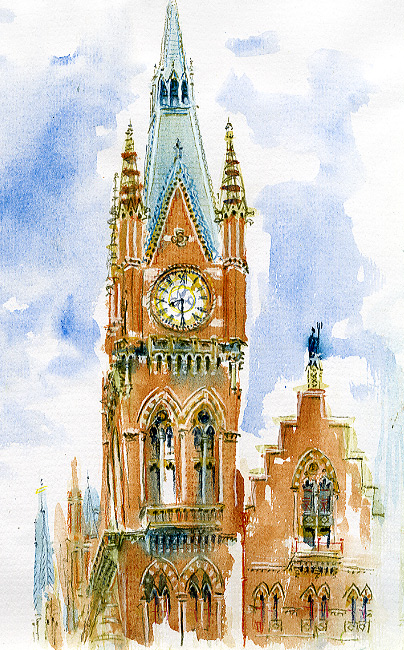
On the Pavement outside St Pancras Station...


Actually, to get the best view (and still be on the sunny side of the street), I was sitting on the pavement outside the neighbouring Kings Cross Station, but it was St Pancras I was interested in. I've been desperate to have a go at sketching it for ages, but I am so rarely in London any more and, when I am, I'm normally rushing around, trying to fit loads in.


To be honest, my recent trip to my publisher was no exception. I thought I'd sketch it after work, but we carried in until quite late and, by the time I had got back to my hotel, it was already 7.30 and I realised I was exhausted (and hungry for dinner). So, I got up good and early the next morning. 

Luckily, I was staying at the Kings Cross Travel Lodge, just across the road. I gobbled my breakfast, got packed up, checked out of the hotel and was on the pavement ready to start at 8.30am. I didn't have time to tackle the whole building - it's huge - so set up where I had a nice view of the clock tower at one end.


I was fortunate that I wasn't needed at Quarto until 10.00, so had an hour to spare before I had to be on my way. I decided on my 'watercolour first' technique, as it's nice and speedy. Then I worked into it with watercolour pencils and, finally, white chalk for occasional highlights.

Kings Cross is very busy. There were lots of tourists but also lots of people rushing past me on the way to work. Several stopped to have a look, one or two stopped briefly to chat. I just about managed to get done in time, though as usual I chopped the top off! 


And then suddenly it was time to go. I shoved everything into my bag and scurried off with my wheely suitcase to join the other commuters and get the bus to Quarto's offices: 


Next time I'm in London, if I can steal another hour, I'll tackle the front entrance of St Pancras I think.

Wednesday, 19 August 2015

Photographed in Action: a Trip to London


As regular readers will know, I am very close now to the deadline for my book, the full title of which is now decided: Sketching People, an Urban Sketchers Manual for Drawing Figures and Faces.  All the scans from my archive of sketchbooks are done, as well as various additional drawings, created specifically for the book (like for how to draw hands and using colour as a framework instead of pencil). 


But one BIG ELEMENT has been waiting until the end... the photographed sequences. These are needed to show how sketches are built up: 


But that's really not something that can easily be done at home, so I took the train down to London and spent two days with my publisher and with Phil Wilkins, a freelance photographer. 


To better explain how I draw different elements of people and how I tackle specific tricky situations, we wanted to show my sketches in stages. But for my style of working, where a sketch is done very fast, stopping at various stages was a problem. Which is why we got Phil to stand behind me, capturing the work in progress. 

I was rather excited and looking forward to the adventure, but also a bit nervous: I wasn't sure how well I would perform under that kind of pressure. 

There was a bit of a spanner in the works too - a tube strike. This meant we had no models, so had to press-gang various people from the surrounding offices to come and sit for me. We started off by drawing the Senior Editor Kate. She was very unsure about the whole thing, but reassured when she saw it was just her hair I was focussing on:


I did someone's ear, as you can see at the top, then someone else's nose and mouth. We scoured the building for someone glam enough to be wearing high heels, then got her to clamber up on a table so I could draw her legs and feet:


The most scary sketch I had to do was left to day 2: to demonstrate a technique for drawing movement, by superimposing different elements over the top of one another. I thought a violinist would be a good option. Luckily, my editor Lily could play. Unluckily, the only violin we could lay our hands on was a child's one which had been gathering dust in someone's attic, so it's slightly smaller than it should be in the sketches. Hey ho. Probably nobody but another violinist would notice.

Once again, Phil set up over my shoulder so he could take pictures all the way through, from first marks to finished drawing. I did two different versions, first with my Koh-i-Noor rainbow pencil, so Lily ended up with lots of arms:


Then I tried again with my Inktense pencils, using different colours for the different overlaid arms. I think it's this one I like best as it's a more interesting teaching technique:


We finished off with a long pose. I wanted to do something on how to plan out a more complex situation, where you have more than one characters and a bit of background. We mocked up a meeting with 
Lily and one of the interns. I sketched a little thumbnail first, to plan the composition, which Phil photographed for the book, then I used this plan to create an under-drawing in my sketchbook, in lilac coloured pencil, before beginning in ink with my trusty Sailor pen:


Every minute or so I paused for a photo. It was really quite an odd way to sketch! 

Once the line drawing was complete, I used watercolour to pull out the light and shade and give splashes of colour. It's not the way that I would normally work, but it's a good technique to demonstrate for beginners and so something that needed to be covered in the book:


The final sketch is not as exciting as I personally like - it's interesting how the more formalised approach made it harder for me to be expressive - but it will do the job. I gave it as a present to the intern, as a reminder of her time at Quarto, as she is heading home to new Zealand shortly. I also gave individuals the pictures of their ears, noses and legs etc.

We had some other jobs to do while I was in London, bit I'll talk about them next time, or we'll be here forever. See you in a few days...

Sunday, 16 August 2015

Urban Sketchers Yorkshire meet Henry Moore


There are always a few of Henry Moore's sculptures nestling in the gardens of the Yorkshire Sculpture Park but, this summer, these have been joined by many more. 


As well several new monster pieces outside, the Underground Gallery is stuffed with drawings, prints and lots more sculptures. I visited a few weeks ago to plan a SketchCrawl and one look set me buzzing with inspiration. I couldn't wait to get back with my art gear.

Urban Sketchers Yorkshire did last Sunday's SketchCrawl in cahoots with the YSP, so we had lots of new people, as well as plenty of regulars. We started in the Moore gallery, as I thought that seeing how he tackled drawing monumental pieces might give people ideas. As you can see, his technique certainly inspired me:


I was pleased to have already seen the work once. With so much to see and only an hour to choose something to sketch, it was even then quite a challenge.


Our 2nd hour was spent sketching the Moores outside in the formal gardens. 


They work so incredibly well in the setting. The contrasts and colours are perfect. My friend Kerry sketched me sketching the watercolour at the top:


We had a spot of lunch, then headed down the hill to the Anthony Caro pieces. Most of the new Caros are a bit hard to sketch. They are big, fairly featureless pieces of red metal: interesting as a contrast with the soft landscape, but not much to get your pencil into. There was one though which had a bit more to offer:


It was quite a giant and I suddenly realised I had left my big sketchbook back at the lunch room. Disaster! A sketch-buddy came to my rescue and let me use her spare book (which was gorgeous 300gsm watercolour paper and much, much nicer than my scanky cartridge). Thank you Jo.


Our last stop was the bizarre field of Dennis Oppenheims: tubular steel trees growing from the long grass and sprouting mostly toilets and sinks.


It was tricky to know what to do with it, but I like the way the steel branches cut across the trees and sky. I sploshed in the background tones and colours then went in with more paint and watercolour pencil line. I was pleased that it seemed quite whimsical:


It seemed a shame to stop, as the sun was shining, but it was time to do the sharing. We headed up to the Hay Loft - a room the YSP had set aside for us. 

When I got there people were already in full swing: 


We passed then book round the table and had great fun looking at what everybody had done. There was some gorgeous work and, as usual, everyone tackled things differently.


Another fantastic day, made all the better by some lovely weather. Thanks to the team at the YSP, and especially Janette, for helping arrange things and giving us so much support on the day. We'll be back...

Wednesday, 12 August 2015

Foreign Translations - Issues with Text


The final, must-have-it-all-done deadline for my urban sketching people book is August 21st and I am delighted (and relieved) to say that everything is on track to be ready in plenty of time. Cue round of applause...


The whole timing thing has been a tad tricky though. I am used to the world of picture book publishing, where I can predict pretty accurately how long things will take me at each stage, but the planning, writing and illustration of this book has been totally different. With no previous experience, it was impossible to know how long I'd need for any of it, which has made it very hard for me to plan my time this year, particularly with weaving it around other projects. 


All a wee bit stressful, especially as, I must confess, I am a bit of a control-freak (ask John). 


One last-minute job I've just sorted, was to find some extra images from European sketchers. This is an interesting ploy by my publisher. Other sketchers who have done books will tell you that there is a big issue with having text on your drawings: it creates problems with foreign co-editions, because the handwritten text can't be translated. Now, if you know my work, you will know I use quite a lot of text...


The discussion started early on, when I wrote a section on how to add value to your drawings by writing snippets of overheard conversation, or any other elements which seem pertinent to the moment. I often like to record incidents (see above), sounds and smells (see below) as an intrinsic part of the image, to better conjure the slice of time, or the place I am recording. 


It was obvious the text needed to stay in place for sketches in this chapter of the book, but then I realised that it would look slightly odd if, having recommended the technique, there was no hand-written text to be seen anywhere else.

My team at Quarto had a bit of a think. My editor said we might be able to get away with keeping English text on my sketches, if we also had lots of other work with handwritten text in a range of other languages. I had already included some foreign language text on the work of guest sketchers - one of my all-time favourite people-sketchers is Marina Grechanik from Israel, who uses loads of text:


But the foreign sales team said that the translation issue is more to do with Europe than anywhere else. So I went on the hunt. It was not easy: most urban sketchers don't feature people much and those who do, don't usually use text. I found several brilliant music ones from a website link someone sent me, like this one by Nicolas Barberon:


But I needed more variety of subject matter. In desperation, I put up messages on various Facebook groups. It worked! 


The wonderful thing was that they came in from lots of sketchers who weren't necessarily well known outside their own country. From the outset, I wanted to feature less high-profile sketchers in the book, alongside the old favourites like Marc Holmes and Inma Serrano. The sketch above is by Enrique Flores, the one below is one by Juan Linares and the bottom one is by Ana Rafful.


The only remaining difficulty was finding space to fit these extra images in, when the book is already pretty much written and the sketches for inclusion already chosen. A bit of last-minute jiggery-pokery was needed. 

Some of the European sketches have been substituted for guest ones I chose previously, some have been squeezed into relevant chapters. We also dropped an idea I was going to include and instead created a new spread, looking more generally at how urban sketching works, where I can talk about the brilliant way the movement has pulled together people from around the globe. 


I am expecting another batch of layouts any day, the latest version of the whole book, which will help me to see any holes, where bits of text are needed, and give me the chance to make any amends before we go to proofing stage. I've seen most of it already, in bits and bobs, but this is the first time I have seen the whole thing together. 

Monday, 10 August 2015

Online Characterisation Workshop: Timing Myself


Things are moving on with my on-line workshop for Craftsy. I have now selected over 100 images from my archive of around 30 children's books, which I will be using to help explain various teaching points as we work our way through the 7 lessons. It's so incredibly useful to have that resource at my fingertips.


All the lessons are now planned in fine detail. The last thing I did was to time it all. I need to aim for each lesson to average out at 15 - 20 minutes. I can have some longer and some shorter: it's very flexible, but that's the target. 

I had no idea how long they'd last to be honest. When I was planning, I just wrote down everything I could think of that I know about character design, then organised it all into 7 categories, and then organised that into logical sequences (each lesson is broken down into 3 sections, which helps a lot with planning).


So, timing... I set the stopwatch on my phone and got started. It takes a bit of getting used to, teaching thin air, but I've done it before, when rehearsing lectures. This time though, I had to draw as I went along, because I have to know how long it takes me to demo everything. I filled sheets and sheets of scrap paper with little characters:


I ran through each section 2 or 3 times (it gets quicker as you improve). Lesson lengths vary from 14 minutes to 26.

As always with my workshops, I could easily fill more time. I can continue to talk all the time I am doing the drawings, which helps, plus I am pretty quick with the sketches. The more demos a class has though, the more time it takes. 


One way I can cut the time is to use pre-drawn sketches instead, though I much prefer to be scribbling away live. I think people like to see that too, watching the process and seeing things emerge. I have had the okay for the timings from my producer now though, so we are going to be fine. 


Most of the sketches I'll be doing are quickies to explain a point, rather than proper drawings, as you can see from the sketch-sheets I created. There is a sneaky trick I can use if I need it though: my producer says, when it comes to more complex drawings which take a bit longer, we can always put in 'jumps', rather than watch the entire process. Clever thinking...

There are going to be 2 cameras filming at all times and I'm told the technical team have all sorts of clever tricks up their sleeve too. It will be so interesting. Getting quite excited now!