Showing posts with label hot tips. Show all posts

Tuesday, 27 November 2018

Mounting Work for my Exhibition


I'm spending this week getting ready for my exhibition. It's less than 2 weeks away! I have been working hard and so have a plan's chest drawer full of textile pieces which need mounting up:


Because the raw, uneven edges of the fabric, and the slight unsquareness, are an important part of the work, I surface-mount each piece onto a stretcher, which I create myself, with John's help. The first time I showed my textiles work, as part of my Orchard Square residency, I bought a big roll of lovely raw cotton from Whaley's, to make the canvas stretchers. Luckily, it seems I have just enough left to do what I need.


That first time, John made all the stretchers for me from scratch, which took ages, but we have now discovered a company where we can buy individual, ready-cut, wooden pieces at different lengths, so it's a much quicker business to put them together. Here's the first one, hot off the press, so to speak:


We have to hand-stretch each one, which is a bit of a tedious business. Pulling the cotton tight to keep up the tension, ready for stapling, makes your fingers hurt, but we'll get it done. 

After that, I use Bondaweb to attach the work to the stretcher fronts (plus a little stitching here and there for the larger work, just to be on the safe side). They look so lovely once they're done. Here's the latest piece I finished early last week, now all mounted up and looking posh and ready for the exhibition:


The show, called Unbound, opens at the Gage Gallery, at KIAC in Kelham Island (Sheffield S3 8DB) on Dec 7th. I am sharing the space with 3 other women artists. Here's a short bit about each of us:


Lynne Chapman

Lynne hand-stitches into fine layers of textile, building up areas of intense colour and texture. Her most recent work is inspired by petroglyphs: the frayed, ambiguous glimpses of ancient stories, the idea that we leave behind an echo, consciously or unconsciously.

Helen Purdie
Helen’s precise and colourful studio paintings and her gestural plein air works are influenced directly by the world around her. As a recently, late-confirmed autistic woman, Helen will also be exhibiting a new autobiographical piece exploring the challenges and beauty of her day-to-day human interactions.

Katie Jamieson
Katie chooses to use materials that have the qualities of softness and absorbency. She is constantly responding to the organic nature of the work. It reflects the balance between creation and destruction; building layers up and knocking them back down again until the whole piece emerges.

Lisa Wallbank
Lisa's whimsical approach to assemblage presents curiosities, fragments and debris from the toybox, in amusing and puzzling combinations. Each artwork invites the viewer to construct a story, but obvious narratives are confounded by details that just won't fit. Or will they?

Sunday, 11 November 2018

Making More Concertina Sketchbooks


This morning, I am making lots of mini-concertinas of watercolour paper, because my next residency, with York University, starts first thing Monday morning! This time I am part of a project which is researching the strategies hospitals use to try and combat cross-infection between sufferers of Cystic Fibrosis. 


We have had a couple of meetings, so I know a little more about it than I did, but I will learn plenty more as we go along. Basically, there are a few specific infections which the rest of us shake off, which people with CF can never get rid of, and which will ultimately kill them. If one CF sufferer already has something nasty, hospitals have to make sure that it's not passed on to other sufferers when they come into the hospital for their appointments.

The project is going to talk to individual patients at hospitals in Leeds, Liverpool and York, while I sketch, to discover how they feel the 'segregation' strategies work for them and what the environment feels like from their perspective.


Anyway, if you are also a sketcher, I thought you might like to have a go at making some easy mini-concertinas at home. This time I am making them from standard sheets (76cm x 55cm) rather than from a roll, which is much more straight forward. 


You start by scoring, ready for the folds. Working down the longer side of the paper, measure and lightly mark at 30.5cm and again at 61cm. Do this top and bottom, then score down right across the sheet at the two sets of marks. I have a special scoring tool, which is very handy, but a dead biro will work just as well.

Next measure along the shorter sides: mark at 22cm and again at 44cm. Now you cut along the length of the sheet at those marks, so you have 3 strips: 


Two of them will fold up to something that is close to an A5 sketchbook. The thinner strip is 'waste' as far as my residency project goes, but makes and excellent little landscape concertina book.

Now the folding. You have only scored every other fold, because they go in different directions (which would have meant scoring on different sides of the paper). So, taking your first strip, fold at the two score lines:


You create the additional folds without scoring. Gently bend the paper, to line up the two existing folds. 


When the edges are lined up, use your palm to press the fold in place, then run your finger down to firm it up. Do this again for the final fold and you have your finished concertina, with 5 facets on each side:


I have already made a cover which fits this size concertina - it was the one I made for my Australian residency, with the Centre for Transformative Work Design in Perth. I created detailed instruction for how to make the covers, when I did my initial residency with the Morgan Centre. Take a look here at how to do it. It's not difficult and, once you have it, you can use it over and over again, as long as you cut the concertinas to the same size.

Right, I'm more or less set for my residency now. Later this afternoon, I take a train to Liverpool, where I am staying overnight in a hotel, ready for an early start at the Heart and Chest Hospital in the morning. I will be sketching two different patients in the morning, then spending the afternoon sketching around areas of the hospital which have come up in the interviews. Wish me luck!


Friday, 27 October 2017

Creating a New Textiles Piece: Start to Finish


Having finished my coffee house piece, but with no particular plan in mind of what to do next, I have decided to go back to pure experimentation. This is always especially exciting, as it pulls on pure creativity, but it's also really quite challenging too. Where to start?

As it happened, I had a bit of a play around with tea and dye-splotting during my recent residency and produced a few pieces of background cotton, which I put aside for an occasion just like this. I started by pinning a couple of different colours of organza on, to break up the space and start a more interesting composition, then chose some initial thread colours:


I then played. I like the way blanket stitch can create interesting curves. I am also very into stitched crosses. The blocks of running-stitch were brought across from my coffee-house piece. I got inspiration for the large sweeping marks from one of the mark-making pieces I created ages ago. I still keep the pile of squares by my desk. They have been so useful, if ever I'm stuck.


I built it up, adding more sections of colour, to create more layers and give it depth, expanding the stitch-colours, trying new marks on top of what I'd already done. It was looking really interesting, but I felt it lacked something. It needed more powerful contrast, a bit of 'oomph'.


Over the last couple of weeks, I have been gradually going through rag-boxes that a couple of people gave me when I first started getting into textiles. I've been ironing what I want to keep, and sorting the bits and bobs into warm and cool colours, patterned and plain, so I can find things more easily. At the bottom of one box I found a tiny tangle of wonderfully lumpy wool. I was about to store it away. Then I placed it on the piece.


I have 'couched' in some wool before, on the first map piece I created, and was really pleased with the textural contrast it provided. This seemed like it was well worth trying...


I didn't overdo the couching, as I didn't want to flatten the wool's lumpiness, so I stitched just enough to keep it in place and to add a subtle glimmer of mustard thread, to tone down the white and help it 'belong'.


One final bit of work I felt it needed was a few stitching additions to the mustard stripes top left. I softened them into the piece by stitching across with some pale blue, which really did the trick and echoed the couching of the wool.


I am pretty sure it's done now. I'll live with it for a bit.

I am really pleased with the overall effect, but also with the way sections of it work, when you focus in on details. It's so hard to photograph this work - you can't really appreciate the layering and detailed stitching when you take a picture of the whole thing, especially with the larger pieces.

Hope you like it! Now... Tea-bags and wax...


Saturday, 26 August 2017

Sketching Workshops: Capturing People


My recent afternoon sketching workshop, People at Play, was completely different to the morning's session on sketching architecture. This time, I was sharing techniques for sketching people, out and about in public.


We met at Sheffield's Botanical Gardens. It's a gorgeous, big park, where lots and lots of people hang out on the grass on a sunny Saturday. Imagine how relieved I was then, that it was not just dry (well, mostly), but also hot. We started with a picnic, while people gradually arrived and watched, in amazement, as a huge group of oddly dressed-up people milled about really close by. One of our number went to ask what it was all about and, with INCREDIBLE good fortune, I had picked the same afternoon as the Sheffield Steampunk Society picnic. Fantastic for sketching!


We started with an easy exercise: using contour drawing to loosen up our arms. This is also a great way to sketch very, very quickly - perfect for capturing people who might move at any moment.


Next, I shared a technique that was shown to me some years ago by Inma Serrano: using just one, at most two colours, to get down very simple shapes in watercolour, finished off with line. This is so speedy to do, especially if you pre-mix a couple of colours. You need to look for the key angles and shapes - the V of the legs, arms in the air, a bent back etc. You can get the gist in 15 seconds.


Then I did a demonstration, to show how, with 5 minutes, rather than 1, you can 'draw' with watercolour, but in a very simple way, not bothering with detail, just capturing shapes again. The trick with people-sketching, is to learn which bits of information are crucial to get down and which you only need if you have time before they move. You can add different coloured line-work, just to define things here and there, but really quickly, keeping 2 or 3 pencils ready at hand, adding as little as you can get away with.


Everybody did really well and worked really hard. The steampunk people loved being drawn and kept coming over to have a look.

I finished with another demonstration, as I wanted to show people how, if I know I have more like 20 minutes to spend, for instance on a train, or sketching friends, I might use my Inktense watercolour pencils to create something more detailed.


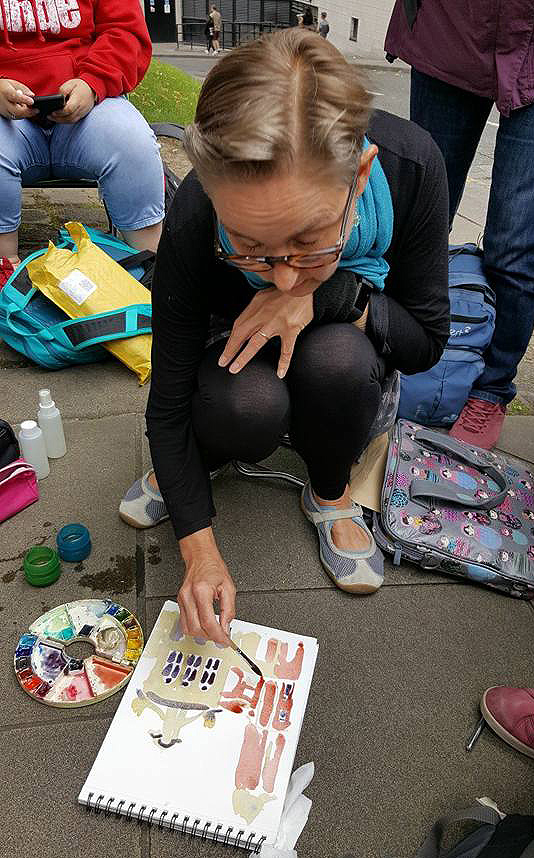
Since we couldn't guarantee any of the members of the public would keep still for long enough, someone's friend sat for me. Which isn't strictly speaking urban sketching, but was the best way for the demo. As you can see, I create the whole thing in line first and only add water with a waterbrush at the end.


I don't run sketching workshops very often but, as I mentioned last time, there is another day coming up very soon, on September 16th. It's all part of my new residency at Orchard Square. The morning is for beginners and is also suitable for children, the afternoon is for adults with at least a little previous sketching experience.


Email me if you want to book a place on either of these workshops. They are almost full, so be quick! 

I'll also be doing and an informal talk about my sketching and textiles work and the ways in which they are linked. If you would like to find out more about this,  or future events, you can join my new mailing list.

In the meantime, you might be interested in some of my other top tips on sketching people or, if you've not seen it already, there's always my book.

Tuesday, 22 August 2017

Urban Sketching Workshops: Scary Buildings!


Remember the 10th anniversary celebration workshops for Urban Sketchers I'm involved in? The first two I ran were in June; the 2nd pair were just recently.


The morning's session was about finding ways to tackle big, scary buildings: sort of coincidental, given my last post about Chicago. I can remember when I used to be put off anything with fancy arches or lots of windows, so I thought I'd share what I've learned since then, about ways to make such things more manageable.


We started off at a coffee shop, for a bit of an intro to what we would be doing. I brought lots of examples of my sketches to show, to help to convey what I meant and hopefully to inspire people.


Then we walked down the road to Upper Chapel, tucked away from all the people on the main roads, with it's own courtyard garden. We even had benches to sit on. I chose it because, apart from the handy setting, the building is only a little bit 'nasty', so not too challenging as a 1st exercise.


I got people to use collage to approximate the overall shape, before sketching and then asked them to try and underplay the amount of details added on top. I did a very quick demo first, as I personally find that is very helpful when I'm trying to learn new techniques. Then they had a go:


I took this little video of them, because they looked so great as a set:


I stepped it up next, with the Victoria Hall. There was a bit more to go at with a tower and different shaped windows. I liked that the building had two basic colours: the brick and the stone, which helped with the technique I wanted to share. I showed them how to use watercolour as a first stage, to help you to simplify what's there before you draw:


I also wanted to demo how to actually use watercolour, showing people the quantities you need to mix up and how to apply the paint: confident, powerful marks, but applied with a light touch, good and wet, so the paint flows about. The idea is to say all the basics in paint and only add the line-work you really need.


Nobody was allowed to plan first in pencil but, as you can see, everyone did great work and people were forced to work in a much looser way than they normally would, when faced with such a building. This is a piece by one of the participants, Lynne McPeake, who took just a section to concentrate on, but used the technique well:


Although I don't run sketching workshops very often, by coincidence there are another couple in a few weeks. As part of my new residency at Orchard Square in Sheffield, I will be running 2 workshops on September 16th - the morning is for relative beginners, which can include families with children, then in the afternoon there's one for adults with at least a little previous sketching experience, which will in fact be a repeat of the workshop that I ran in Chicago. Everyone booking for this event will get a copy of the fully illustrated handout I created (as a PDF).

Email me if you want to book a place on either of these workshops.

I'll also be doing an informal talk about my residency work on the morning of September 23rd. For details of this and other future events you can join my new mailing list.

Thursday, 17 August 2017

How to tackle BIG Buildings!


It took me a while to get my head round the scale of the architecture in Chicago. It was not just that everything is so incredibly tall, although that was tricky enough: how on earth do you fit all that stuff onto your page?


It was also the relative sizes of the skyscrapers. You think one building is high, then you realise the one beside it is nearly twice as high. So, if you fit the tallest one in your book, the slightly less enormous ones become pretty small, which of course means you have to draw everything else super-diddy size!


And then there's the problem of all the windows. SO many windows. Hundreds, thousands... I wouldn't want to laboriously draw them all. Apart from anything else, it generally makes your work look terribly fussy if you do. And who has that kind of time?

So, I spent my time in Chicago gradually learning how best to 'code' the architecture, how to say more with less, to give the impression of all those windows with different marks and patterns.


Plus, I learned to come to terms with the fact that sometimes you have to cheat, as I did here, and make very different height buildings much nearer in size, so they'll all fit in...


Or you have to just get used to the idea that you quite often have to chop stuff off. Hey ho.


Once I loosened up a bit, I had a lot of fun with this more playful approach. It reminded me of when I first discovered that I could take incredible liberties with scary buildings, during a workshop with the brilliant Inma Serrano, at the symposium in Barcelona.

I got quite carried away with the this looser freedom, when trying to capture the ENORMOUS Buckingham Fountain against the impossible Chicago skyline:


It was much the same at the Talking Heads, filmed-concert evening I spent with ace sketcher and fellow instructor Stephanie Bower at the Jay Pritzker Pavilion (which looked like nothing so much as an exploding, metal monster). We had a picnic and a bottle of red wine and all was well with the world. We both love Stop Making Sense and whooped and sang as we painted (the red wine may have helped with that):


The whole 'coded windows' approach fed well into my workshop too. Since I was already teaching about mark-making, I incorporated the idea of giving an 'impression' of what you see, rather than drawing the reality. This was a demo sketch I did for one of my groups in Lurie Garden, exploring just how little you can get away with saying:


Next time: working up the courage to paint Anish Kapoor's Cloud Gate, more commonly known as The Bean!

Tuesday, 15 August 2017

Experiments in Collage...


 I had a very nice email last week from a lady I met briefly in Chicago. Susan Cornelis is an artist from California. She had been at the symposium with her friend Cathy and Cathy had taken my workshop


Cathy so enjoyed the collage element of the workshop, that she shared the technique with Susan and they both went out on a sketching day together as soon as they got home, to try it out.


They were so excited by their results that they sent them to me. How lovely is that? I though you might like to see them too.


Try it - get some coloured paper and rip a couple of random shapes. Stick them into your sketchbook before you go out to sketch. they can overlap, or not, up to you. Then do whatever drawing takes your fancy over the top.


The results are often very effective and all the more interesting because the relationship between the colour and the line is so random.

Monday, 7 August 2017

Paint & Paddle: Urban Sketching in Chicago

I am back!


Sorry for going a bit off the radar. I have had a smashing couple of weeks, drawing and painting on the streets of Chicago with my Urban Sketchers chums.

For those who aren't aware of what it's all about, every year Urban Sketchers, which is an international charitable organisation, holds a symposium somewhere in the world. This year, 600 sketchers descended on Chicago! The event itself lasts for 3 days, but people often hang out and sketch together for quite a few days more.


Instructors, like myself, are flown in from around the globe to run workshops and do demonstrations. It's fairly hard work, especially in the heat, but I can't complain, since these symposiums have taken me to Brazil, the Dominican Republic, Portugal and Spain.  


I worked with 3 different workshop groups in Chicago: one group each day. I took them to the same location, Lurie Garden, which I had to choose before I left Sheffield, using Google Maps. It was a bit of a gamble, but it turned out to be ideal: a peaceful, 'secret', wild-flower garden in the centre of the city, with the visual contrast of massive skyscrapers all around the sky-line. I arrived a few days early and went to sketch there, to get a feel for it. Within seconds of settling myself down, huge rain splots started to fall and the sky turned purple! I had to scurry under a tree to finish while thunder boomed overhead.

Luckily the next day it was somewhat calmer:


One unique thing about Lurie Garden (which made the other instructors jealous) was the cool water channels you could dabble your feet in - spot the paddling student:


And, because we were really close to the park's big, open-air music pavilion, we were mostly painting to musical entertainment. One morning we had opera, another it was pop. Fantastic!


Like all the instructors, I was with each group for 3.5 hours. Each year I devise a different challenge for my students, something which either addresses key difficulties people have when sketching on location, or which helps them to think in a new way about how they sketch what they see.


This year I got people thinking laterally about the way they combine line and colour. I got them really experimenting with the way you can layer different kinds of mark-making. It was completely different to any workshop I'd run before and a large part of it involved using simple collage. Which meant that I had to find room in my suitcase for three A3 packets of coloured paper. I was also slightly anxious about doing paper collage out of doors in the 'windy city'...


It all went really well though and we only had one incident of having to chase down brightly coloured bits that flew off. We'll get more formal feedback soon, but people said they enjoyed themselves and that the level of challenge was good. They certainly did some gorgeous work:


I of course did lots of lots of personal sketching, in my spare time during the symposium, when I wasn't teaching, but also on the few days I tagged on either side. I was particularly excited by the fiendishly tricky El train, which runs above the street. I sketched it 3 or 4 times:


I'll post some more of my sketches in a few days. I'm still working my way through the various jobs that build up when you go away.

On the final day of the symposium, there is always is big announcement: where next year will be held. There are always rumours, but I didn't guess Next year we are going back to Portugal, this time to Porto. I went there on holiday years ago. I remember it as being extremely sketchable, with twisty, old streets, interesting cafes and of course the wide Douro river at its feet, with its massive iron bridge. Can't wait! 


By the way, I have decided to set up a mailing list for my urban sketching workshops. So, I know I don't do them very often, but sign up if you want to be contacted when I am running something, to get first refusal on any places available!